PROLOGUE
THE SLEEP OF THE ALTAI AND THE WAKING CODE
""When the last sage sealed that door, he did not weep for what was lost. He wept for the loneliness of the mortal who would one day be compelled to open it." — The Ergenekon Codex, Seventh Tablet—recovered from the antechamber of the Chrome Kurgan."
15 MINUTES
Time had long since lost its earthly dominion on the summits of the Altai. The guilt of centuries, the steel wreckage of forgotten empires—all of it lay buried on these heights beneath a heavy shroud. Above, the sky was silent. So was the earth below. The wind passed over the ice like a lament; there was no other sound. Not yet.
At the heart of that white nothing, one mortal body walked, splitting the silence: Aral.
Every step he drove into the knee-deep snow left a dull echo in the mountain's stillness. Over his shoulders lay a heavy synthetic pelt, woven in the shape of a wolf's hide in the laboratories of the old world. Small crystals of ice had gathered along its hem. His breath froze in the air.
The Göktürk runes that ran down his neck and temples, synchronised with his nervous system, glowed at a faint turquoise frequency, keeping time with his heartbeat. They were not ink. They were an equation his ancestors had left him: an epigenetic cipher moving beneath his skin. The choice had been made by the hands of those who lived before his birth. Now he only carried it.
The ancient staff in his right hand held him up. Its shaft was carbon-tungsten; its falcon-headed crown a graphene conductor that carried the frequency of his blood into the earth. On his left arm he bore the price of his past: a prosthesis cast from the same carbon-tungsten, running from his shoulder to his fingertips. Where flesh met metal, at the crown of the shoulder, he carried a scar burned a reddish black—a border where the two tissues had not made peace and did not intend to. Turquoise runes etched into the surface of the prosthesis trembled faintly in the cold air, and the micro-fission core within it fell into resonance with the mountain's electromagnetic pulse.
Of the day the arm was lost, Aral would not speak. That day he had left two things beneath the snow; one was the arm. The name of the other he had buried along with the silence he gave the arm.
Between his cybernetic fingers lay a tablet that an unknowing eye would take for an ordinary shard of stone: the .
It was the size of a hand mirror, a single finger thick. Obsidian: the black of volcanic glass, worked by the hand of the old world. Its surface was smooth as a mirror but it was no mirror; it did not reflect light, it took it in. When it fell into resonance with the frequency of Aral's blood, the capillary channels cut into the heart of the glass—fine lines invisible to the naked eye, surfacing from within only at the right frequency—would give off a bluish tremor. The tremor was neither steady nor rhythmic; it was the tremor of a thing that breathes.
In one of those channels lay blood sealed to stay unseen. A woman's blood, poured into that channel two hundred and twenty-eight years ago, the glass staining red for an instant, then the seal closing over it. The glass kept the blood in its own darkness as a single drop of red. The frequency in Aral's veins heard that blood beneath the stone. It knew whose it was, too. The tablet's true light was the quickening not of the stone but of the blood.
On its back were runes written to the crackle of the chisel. . Lines that wandered between an engineering report and a testament. Aral had heard these in childhood in his mother's lap; now, on the stone, beneath his fingers, he felt them.
When he reached the wide flat of the summit, the storm fell still, as though it had struck an invisible will. In the sky the northern lights, emerald green and electric blue, rippled in splendour; the centuries-old veil of mist drew slowly apart.
Before Aral stood a structure that bore what the mountain could not.
.
A black pyramid rising from the mountain's own stone. A surface cast from carbon-metal, yet shining with the calm of marble. From its peak a thin white beam of light climbed into the freezing night sky, sending its greeting to the aurora. The structure had settled beside the mountain without wounding its measure; it was not the work of a god, but of a human hand. Its base was the square of nineteen: each side three hundred and sixty-one paces, its height the same. The one who built this had not simply counted nineteen; he had listened to it through its square. Aral did not multiply the numbers. The numbers were already his, cut into his blood.
The name of the hand that chose the numbers stirred on his lips:
Bumin.
Twelve generations had passed since his time—so the count went. The mountain did not count.
Bumin carved this structure. He sealed it with Tomris, his wife. From that first chisel-stroke they waited. The structure faced not Aral, but the word of the hand Bumin awaited.
Aral crossed the snow-covered flat and walked to the threshold of the structure. On either side of the way, before the door, two sentinels stood.
They were not statues.
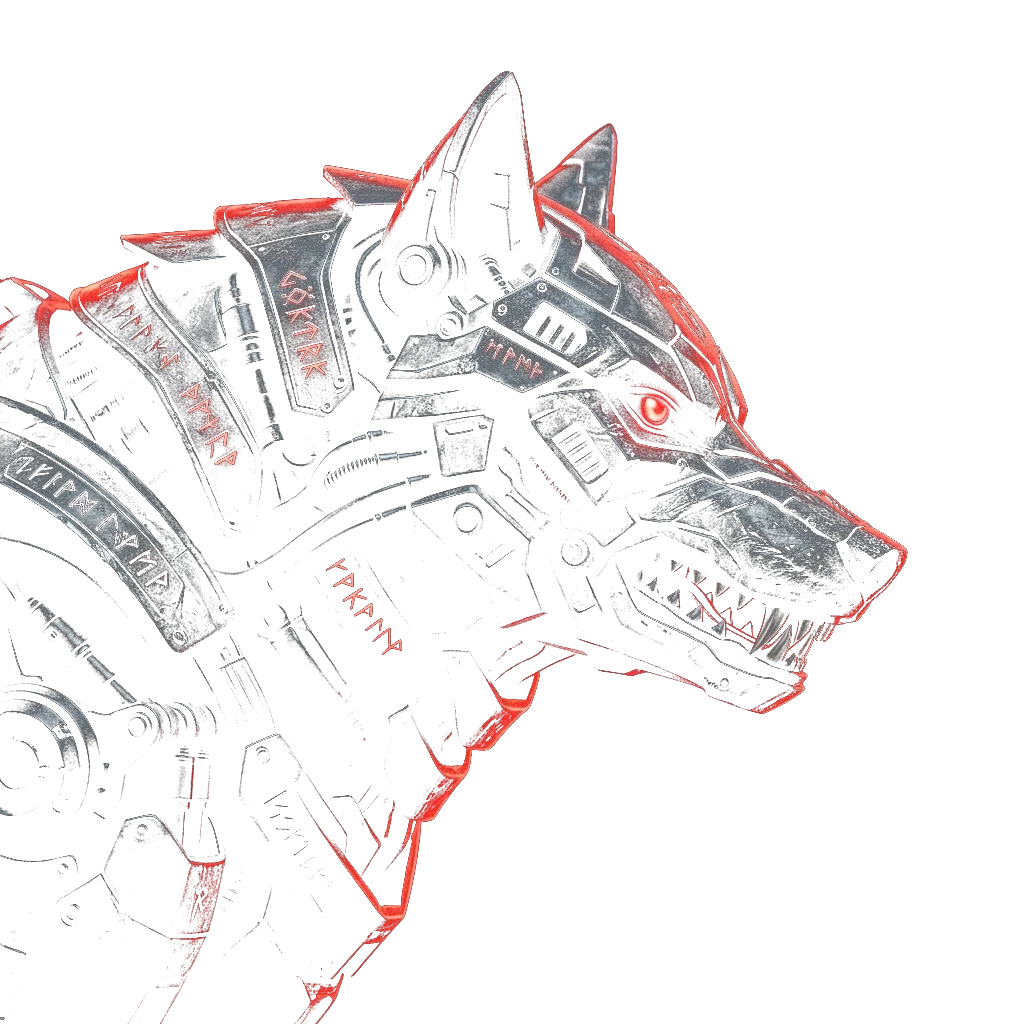
Mechanical Asena. Guardians forged from the steel of the old world, but their bodies shaped to the anatomy of a wolf. Nineteen metres tall: at their threshold Aral stood no higher than a child; their carbon-metal bodies a matte black that did not give the night back. Their joints were woven with heavy hydraulic pistons and superconducting cables; the turquoise runes cut into their manes blinked with a pulse. As Aral drew near, their bodies stirred, and the snow that had gathered on their backs for years broke into a thin avalanche and spilled from their shoulders. Their optic eyes woke; the turquoise flame was dim at first, then cleared as it knew the frequency passing through Aral's blood. The energy cores in their ribcages trembled like living things hearing a wakening call, centuries old.
They had not been made to know Aral. They had been made to know the one who made them.
The two Asena bowed their heads with a seismic tremor. Before the grandchild they had awaited for hundreds of years, the plainest salute iron can give.
The smooth chrome doors knew the frequency of the Tablet in Aral's palm; with a heavy hum they slid apart.
When he took his first step inside, for a moment his foot could not find the ground.
He had come from the small world of snow and acid haze: from the world of rusted shacks, of earth the acid had stained a yellow-brown, of the blighted multitudes. Here nothing was blighted. The walls were geometric lines of gold cut into black stone, quantum runes glowing with a deep ember light. A ceiling whose height he could not see did not crush him—it stopped him. Aral laid his gloved right hand against the cold wall. Beneath his palm a pulse ran through fine fissures branching like veins. Not the pulse of the earth, but of an architecture sleeping beneath the mountain. His breath hung in the air.
He did not hide his wonder. There was, in any case, no eye watching him to judge it. There was only a wall, and behind the wall, a structure that had waited more than two centuries.
Bumin, he said within himself. For whom, for what, did you build this?
There was no answer. There was only the pulse beating beneath the stone.
He lowered the staff from his shoulder and struck its tip against the stone floor before him. The dull sound spread to the far walls of the corridor; the runes along the walls, as if in deference to that sound, blinked in turn and showed a way.
Along the corridor the walls spoke.
They were data-transfer nodes recording how his ancestors had read the cosmos; but in Aral's eyes, they were the sound of obsidian crackling beneath a chisel. The passage of Bumin's hand could be read in every metre of the corridor. Here, into one relief, the frequency of the melody from Tonyukuk's kopuz had been cut; at the right touch the stone would whisper that melody again. Beyond, the double-helix signature of Bumin's wife, Tomris, had been worked in like a will left to the next generation. As Aral passed before the reliefs he heard Bumin's breath, Tomris's breath, and the echo of an argument carried between them. The structure was not dead; beneath its architecture lay the lives of two ancestors and the future of an unborn child.
Halfway down the corridor, the wall seemed for a moment to widen. Aral's eyes caught on an inscription stretched there. It was not like the other images: a single sentence, cut into the stone by the tired strokes of Bumin's own hand. Around it there was no other ornament; only that sentence and the emptiness around it. Aral stopped, and read:
"Lo! We offered the trust unto the heavens and the earth and the hills, but they shrank from bearing it and were afraid of it. And man assumed it. Lo! he hath proved a tyrant and a fool."
The Ancient Word
A warning, or a welcome—perhaps both. As Aral read the inscription, the pulse beneath the stone slowed for a moment; the wall, too, had a waiting ear.
Aral bowed his head. He looked on these images and writings as a lexicon his ancestors had left him. Bumin had not chosen the numbers, he had listened to them. The same frequency his ancestors heard, he too had heard and carried to the walls.
You were weary, Aral said within himself. You cut your weariness into the stone as well. The weariness of bearing the trust.
He weighed the same burden on his own shoulders: the same trust, the same weariness. Bumin had begun; the finishing fell to him. He had never come this close to the mark.
The corridor opened all at once into an expanse. This was the Hall of the Guardians. On either side of the way, ranked facing one another, stood thirty-eight Mechanical Asena, nineteen to a row. They were half the height of the two sentinels at the threshold, guardians of the hall with their ten-metre bodies. Black, smooth carbon-metal. A frost hundreds of years old had sealed their motion but could not cool them. At his approach, one by one their optic eyes woke; the energy cores in their ribcages trembled with a moan from deep within. The hall became a choir that began slowly and rose to its peak as Aral reached the centre.
Aral did not count the numbers. He felt the mathematics of Bumin's hand.
At the centre of the hall, where the two rows of Asena ended, a small side threshold opened. As Aral turned towards it, the turquoise sensors of the Asena stopped glowing behind him and passed into a dull reverence.
The room beyond the threshold was not large.
The ceiling was low; the walls plain. No lamp burned, no torch. Only a thin white light, filtering from a single vent in the ceiling, fell on the surface of a stone sarcophagus at the room's centre. The air was damp: the damp of a cave that has held no snow; not cold, but still. The sarcophagus had been carved from the mountain's own stone. On it was a single sentence, in Göktürk runes:
TOMRİS YAVUZTÜRK
MORTAL SHE REMAINED. MORTAL SHE SHALL REMAIN.
No date. No khatun, no khagan. A name, one line, an oath.
Aral sank to his knees.
The moment his knees met the stone, his bones ached. The flesh beneath the synthetic pelt had opened, uncovered, to the mountain's centuries-old cold. His staff fell to the stone floor. It made a dull sound as it fell; the sound struck the walls of the sarcophagus and turned back and filled the room's one second of silence from within. His pelt slid from his shoulders. The frost that struck his back split his skin like a knife; the hairs at his nape stood on end. He noticed how the air entering his nose burned in his lungs; the breath that left him laid a small cloud of vapour on the surface of the sarcophagus and at once went out. His right palm trembled faintly; the fingers of his left prosthesis were still. The two hands belonged to the same body, but they knew the cold differently.
The name was not unknown to him. His mother had spoken it in his childhood.
Aral remembered his mother's voice the way one remembers a voice coming from behind a closed lid. In the half-light of winter evenings, in the flickering light of a hearth, his mother would whisper a name as she stroked his hair.
Tomris. Bumin's wife. Tomris. Bearer of the Yavuztürk blood. Tomris. The woman who had mothered her unborn grandchildren.
His mother spoke this name with a devout prayer, but as a child Aral would not listen to the prayer. Tomris's name had stayed in a corner of his childhood like a door never opened. Only now had Aral reached the one behind that door.
He drew off his glove. He laid his bare fingers against the cold surface of the sarcophagus. The stone was cold; the stone was dead. But the frequency passing through Aral's blood woke a ticking beneath the stone. The sarcophagus knew him.
On the plain surface of the sarcophagus, in a place the light touched, there was a small rise beneath his fingers. A point where Bumin's chisel had trembled for an instant, then steadied. This small flaw, left two hundred and twenty-eight years ago, was the mark that the hand which made the stone had also been mortal. Aral held his finger on that point. There had been days when his own hands trembled, too.
At the end of the spring of his seventh winter he had stood at the head of a small stone. The grave was still unwritten; death was so fresh that the mother's name had not yet been cut into the stone. That day Aral had learned to lay his fingers against the cold surface of a stone. Years later, now, his hand touched Tomris's sarcophagus the same way: to hold a finger at the point where the hand that carved the stone had trembled for an instant was the kinship not of stones but of hands. Two women, two stones, one grandchild. The two ends of a vein that speaks by falling silent.
"I have come, Ancestor."
His voice did not spill into the darkness of the hall; the smallness of the room held it tight.
"I have come, but I have brought the shame in me as well. Of my ancestors' pride I have paid the price most of all; but if I open this door, others will pay it too. I had no one else to speak this with; I brought it to you. Whether you called me to cleanse me, or to hold the door, you are the one who knows."
He fell silent. The sarcophagus listened.
"Whether you called me, or the blood called me, I do not know."
He fell silent. The sarcophagus gave no sound; but a pulse beneath the stone, as though it had heard him, grew heavy for a moment.
"My mother would whisper your name."
Something caught in Aral's throat. He swallowed. The memory of his mother mingled with the damp of the room.
"I was a child. I would not listen. My mother spoke of the mathematics of the cosmos; I would say, Mother, what are you saying? and grow bored. She would laugh, she would not give up; each time she came back to your name. I did not know that your name was the mathematics itself."
The sarcophagus listened to him. The stone of the sarcophagus did not teach him what to say; it only listened. The ancestor did what all ancestors do: did not judge; listened.
"Perhaps my elder brother is right. Perhaps this door should never open again, and I should lie here in this room with you. Perhaps when I withdraw from the door, humanity will sleep more easily."
He held his palm on the sarcophagus. Over Tomris's name, he felt the stone between his fingers. The blood sleeping beneath the Tablet in his cybernetic hand was from the woman who lay beneath this sarcophagus—the hand that, in the eighth month of her pregnancy, had cut her left palm with a knife and let her own blood into the capillary channel of the glass. A woman, two hundred and twenty-eight years ago, had sealed her own blood into a stone her unborn grandchild would one day carry. What the Tablet could not tell him, the blood beneath the stone told: Blood calls to blood.
"Whether I deserve this, I do not know."
A breath.
"I do not deserve it."
He fell silent. The sarcophagus stayed silent again.
"But I am here."
It was not a prayer. It was a surrender.
He stayed a moment longer in his kneeling. His remembrance of his mother had mingled with the damp of the room; that remembrance became one with the blood beneath the stone. Two women—his mother, and the ancestor of his ancestor—met in Aral's kneeling. He felt it in his heart: blood did not only call to blood. Blood knew blood.
He drew the synthetic pelt over his shoulders. He took his staff from the ground. He put the glove back on. A different cold had settled inside it—not the cold he had felt when he drew it off—but there was no one to notice.
He stood a second longer at the head of the sarcophagus.
"My mother was right," he said. "Your name was mathematics."
Then he turned to the threshold.
did not move. But the turquoise in their reflections was a little dimmer. Those ancient guardians seemed to have heard Aral's inner word. Iron spoke not with words, but with the silence beneath words.
As Aral crossed the hall, he was no longer the man who had knelt there minutes before. Before the sarcophagus a part of him was sealed. The absence of the sealed part made the remaining part lighter. The structure met him now not as an inheritance he had to carry, but as another body that gained its own face as he passed through it from within.
The end of the hall opened into the darkness of the dome. Aral crossed the distance in a few steps.
This was the very heart of the Chrome Kurgan, the Core Chamber. At the exact centre of the space rose a great wolf monument, as if it had burst from the mountain's core. Its surface was sheathed in superconducting pipes running vein by vein, the main conductor that carried energy and data into the depths of space. At its feet lay the circular Main Terminal, the linchpin of everything; at its exact centre, the ancient Altar.
Aral came with heavy steps to the front of the Altar. The muteness of loneliness gave way to a silent surrender. From his cracked lips fell words that echoed like a prayer in the depths of the dome.
"If humanity is to drown in its own ambition and perish with its false gods, then let this swallow us forever. But if in the mind, the mercy, and this code the Creator granted there remains a single drop of truth that can unite the cosmos… then wake."
He reached out his left cybernetic hand. He set the Ancient Tablet into the socket at the exact centre of the Altar, with millimetric precision. The obsidian settled into the stone; into a socket prepared hundreds of years before, a tablet cut in the same age—a perfect accord. The frequency deep in the stone knew the genetic signature in Aral's veins.
He locked his fingers into the centuries-old interface of the system.
At first nothing happened. Only a deep hollow of breath.
Then from the metal at his fingertips an electric current spread into his body, scorching, burning his mortal flesh. The searing pressure that rode his nerve-endings struck into the folds of his brain like lightning. He clenched his teeth; he felt, cell by cell, how his telomeres burned for the sake of this current.
BOOM.
A dull, rhythmic heartbeat broke loose, as though it came from the mountain's core. The ground shook.
BOOM.
With the second tremor, the Göktürk runes ranked ring on ring around the Altar blazed with a blinding turquoise light. The light climbed like a net of lightning from the Tablet to the Altar, and from there to the pipes sheathing that great wolf monument. The Main Terminal, dead for hundreds of years, came to life; behind the great statue burst open a vast vortex that set the air trembling, a quantum storm, bending space-time. The blaze turned the room to day in an instant; the shadows were wiped from the walls.
When his own mortal nervous system linked to a memory hundreds of years old, the grief of the billions of ancestors who had died became his in an instant. Countless voices, countless deaths, melted into a single roar. He clenched his teeth so his knees would not give under the weight. His flesh was burning. His nerve-endings were burning. He did not draw back his hand.
And in that second, from the peak of the giant wolf, breaking through the roof of the Kurgan and cleaving the heavens in two, a great column of light made of pure quantum data burst towards the depths of space.
This was the . After hundreds of years, the Tree of Life took hold again, its digital roots in the soil of the cosmos.
Aral knelt beneath the beams of turquoise light raining down on him, and stayed there in stillness. He, and the thunder of the heavens.
In a room on the other side, a stone sarcophagus gathered the light into its own stone.
The signal had been given.
◈ END OF PROLOGUE ◈